

Robert Edmond Jones: The Dramatic Imagination
"And now we must make it."

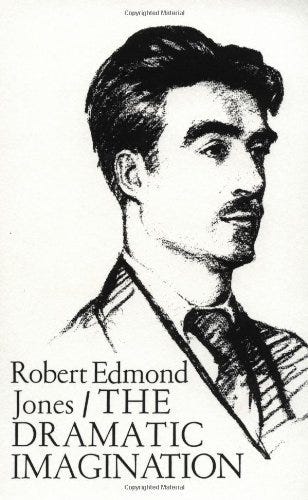
I seem to be in the midst of a urge to read or reread inspiring books about theater. It started with Peter Brook’s The Empty Space, which I will write about later, and really set sale when I finished Sara Farrington’s The Lost Conversation, which I wrote about a few days ago.
I’m not sure what has taken me in this direction. Maybe it is a sense that finally theater people are considering whether we might have taken a wrong turn, and are being drawn back to the past before forging a path forward.
Yesterday, I was drawn toward Robert Edmond Jones’ 1941 classic The Dramatic Imagination. Jones was a groundbreaking designer of scenery, lights, and costumes, and his book discusses all three, but his main topic is the pure power of the imagination and the importance of theater as a way of allowing everyone, both artists and audiences, to experience a glimpse of a transcendent world.
His style of writing might best be described as “thick description,” to borrow an anthropological term. I find myself thinking of a painter who applies layer after layer of paint to their canvas, creating depths that seem to glow through the surface of the painting. He adds image after analogy after reference after metaphor after fact until something emerges from the depths of his mind that seems to contain all of those elements at once, like a stirring chord played by many instruments.
In a chapter called “Some Thoughts on Stage Costume,” he uses as a prompt thirteen lines from John Milton’s poem Samson Agonistes, and from there we are given a fascinating 12-page description of his mind at work. I’ll give you a few examples:
…a costume of Milton’s own time will inevitably express the characteristic qualities of mind of life at that time. Let us bring to mind what we know of these qualities. Great names arise in the memory: England: Elizabeth the Queen, the sovereign who once said, I could have wept but that my face was made for the day: Sir Francis Drake, the defeat of the Spanish Armada, the streets of London all hung with blue, like the sea: William Shakespeare, author and player, the greatest master of public art the world has ever know: Marlowe, with his “mighty line” — Kit Marlowe, stabbed in the Mermaid Tavern in Southwark over across the bridge; Sir Walter Raleigh, with his cloak and his sea-knowledge and his new colony, Virginia, in the west on the other side of the world…
The list goes on, layer upon layer, and upon and, until a sense starts to emerges:
As we dwell on these things, the dramatic imagination begins to sketch in our minds the first vague outlines of a costume. It is bold and fantastic and elaborate and ceremonious and splendid, a typical expression of the Age of Daring.
He then moves on to Milton’s “mood out of which he contemplates his subject.”
Milton’s mood is mature, noble, grand. His season is autumn, splendid and serene, a “season of mellow fruitfulness.” And we find in his poetry a great elegance, a slightly rigid elegance perhaps, like the elegance which is at times almost a constant in the music of Handel or Purcell. It is often gay, jocund, buxom, one might say; hearty, with a great natural health coursing through it…”
And on he goes, until suddenly he declares, “All at once we see it. The figure—I had almost said figurehead—draws near and in our imagination we watch its majestic progress across the stage… We see it for an instant, plain and clear. Now it has vanished. We saw it. And now we must make it.”
Jones sees theater as a process of evocation, a summoning of life out of the imaginative ether of the collective and individual unconscious. I’m reminded of Faustus convincing Mephistopheles to conjure the image of Helen of Troy, who rises out of nowhere to enchant Faustus.
Jones was writing in 1941, a year when people were once again prophecying the death of theater, which he says he has not taken seriosuly in the past, “but this time there is greater content of truth.” It is a time not unlike our own, in which the theater is “dwindling and shrinking away… It is essentially a prose theater, and of late it has become increasingly a theater of journalism. The quality of legend is almost completely absent from contemporary plays.” While he had grown up in a theater of realism influenced by photography, movies, he says, have taken over that style, since movies are photography plus movement and voice, and by doing so, it has given permission for artists to create “a theater set free for beauty and splendor and dreams…”
The loveliest and most poignant of all stage pictures are those that are seen in the mind’s eye. All the elaborate mechanism of our modern stage cannot match for real evocation the line [from King Lear] Tom’s a-cold. A mere indication of place can send our imaginations leaping…It is this delighted exercise of imagination, this heady joy, that the theater has lost and is about to find once more.
And he was right. Three years after his book was published, we had the first production of The Glass Menagerie, followed quickly by A Streetcar Named Desire and Death of a Salesman, all straining away from realism toward some level of poetic imagination. Jones looks back toward Marc Blitzstein’s famous 1937 production of The Cradle Will Rock, Orson Welles’s Mercury Theatre modern-dress, bare-stage production of Julius Caesar, “the procession of wet black umbrellas in the funeral scene of Our Town.”
Finally, he declares:
The only theater worth saving, the only theater worth having, is a theater motion pictures cannot touch. When we succeed in eliminating from it every trace of the photographic attitude of mind, when we succeed in making a production that is the exact antithesis of a motion picture, a production that is everything a motion picture is not and nothing a motion picture is, the old lost magic will return once more… We need not be impatient. A brilliant fresh theater will presently appear.
And here in 2026, as the old Broadway and regional theater wobbles under the weight of Too Much, I find myself believing in Jones’s faith that something new is waiting to be born. If only artists can be reminded of the nature of that “old lost magic,” which Jones is still in touch with and can sense, but which will take a new form that will reflect our own time and our own imagination, then something new will arise. We saw glimpses of it in the work of the artists Sara Farrington interviewed, most of which was cut short by the AIDS epidemic.
But today we are called on to once again use our dramatic imaginations to summon the new thing.
There are theater artists interested in the kind of work you describe. I happen to be one of them. But many of us have been shut out because our interests are not in the activist fury of the day but in craft, innovation, form & content, and (dare I say it) universal themes. But as you suggest early on, the theater has taken a wrong turn. Yet then you move on without discussing what that wrong turn was, and why the theater is still on that path. It made national news this week—a field that says it’s committed to “inclusion” showed its true colors. It was a missed opportunity to have a worthy conversation. Instead, the theater shunned a heretic.